

There is something uniquely unsettling about a story that doesn’t ask you to fear its protagonist, but to understand him, perhaps even, at moments, to agree. You thrives in that discomfort. It is less a thriller in the conventional sense than a slow, insidious act of alignment, drawing the viewer into the perspective of a man whose capacity for violence is matched only by his talent for rationalisation. In doing so, it exposes a more disquieting truth: obsession, when framed correctly, can masquerade as care.
Developed by Greg Berlanti and Sera Gamble, and adapted from the novels by Caroline Kepnes, You situates itself within a lineage of psychological thrillers that includes American Psycho and Gone Girl. Yet where those works maintain a certain distance from their protagonists, You collapses it entirely. Its most defining device the persistent internal monologue of its lead functions not just as narration, but as manipulation. The audience is not merely observing; it is being persuaded.
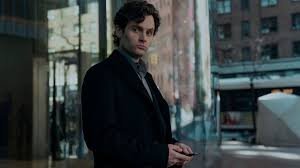
At the centre is Joe Goldberg, portrayed by Penn Badgley with unnerving precision. Badgley’s performance hinges on duality. His external demeanour is controlled, with an almost gentle, measured speech, soft vocal inflections, and a physical stillness that signals attentiveness. Yet beneath that surface, his internal voice delivered through narration reveals a relentless, often chilling logic. The contrast between what Joe says and what he thinks is where the performance finds its tension. It is not the violence itself that unsettles, but the reasoning that precedes it.
What makes Badgley’s portrayal particularly effective is his refusal to lean into overt menace. Joe does not present as dangerous; he presents as thoughtful, observant, even considerate. This dissonance forces the viewer into a position of complicity, recognising the seductive nature of his perspective even as it becomes increasingly untenable.

The series’ rotating cast of supporting characters each season introducing new objects of Joe’s fixation serves as both counterpoint and catalyst. Performances are calibrated to reflect the shifting dynamics of power and perception. These characters are not merely victims or foils; they are individuals navigating their own complexities, often revealing that Joe’s interpretations are as flawed as they are persuasive. The interplay between perception and reality becomes a central tension, one that the series exploits with increasing sophistication.
Technically, You adopts a visual style that mirrors its thematic concerns. The cinematography often frames characters through barriers windows, glass, doorways reinforcing the motif of observation. Joe is frequently positioned as both watcher and participant, a duality that the camera subtly emphasises. Close-ups are used sparingly but effectively, drawing attention to moments where the façade slips, however briefly.
Editing plays a crucial role in maintaining the series’ rhythm. The interplay between Joe’s internal narration and external action creates a layered pacing, where moments of apparent calm are undercut by the knowledge of what is being concealed. This structure allows tension to build not through spectacle, but through anticipation what will Joe justify next, and how far will that justification extend?
Production design contributes to the illusion of normalcy that defines Joe’s world. Bookstores, apartments, suburban homes these spaces are rendered with a lived-in authenticity that contrasts sharply with the violence they contain. The familiarity of these environments is key; it reinforces the idea that the series’ horror is not exceptional, but embedded within the everyday.
Sound design and score are similarly restrained. Music is used to underscore shifts in tone rather than dictate them, while silence often amplifies moments of realisation or dread. The absence of overt auditory cues places greater emphasis on Joe’s narration, allowing his voice to dominate the viewer’s experience.
At its core, You is a critique of the perception of how we construct narratives about others, and how those narratives justify our actions. It interrogates the cultural language of romance, exposing how easily it can be twisted into something possessive, even predatory. In an age defined by social media and curated identities, the series feels particularly resonant. Joe’s obsession is facilitated not just by his own psychology, but by a world that encourages visibility without understanding.
This thematic focus aligns You with Gone Girl’s exploration of performative identity, though it replaces that film’s dual perspective with a singular, immersive viewpoint. Similarly, it echoes American Psycho in its portrayal of a protagonist who navigates society through a carefully constructed façade, yet it diverges by emphasising emotional rather than material obsession.
However, the series is not without its flaws. Its reliance on Joe’s narration, while central to its appeal, can become repetitive, particularly as seasons progress. The cyclical nature of the narrative new setting, new obsession, familiar pattern risks diminishing the impact of its revelations. At times, the show leans too heavily on coincidence or contrivance to sustain its momentum, stretching plausibility in ways that can momentarily break immersion.
Yet these limitations are, in some sense, inherent to the series’ premise. You is less concerned with realism than with psychological consistency. It is not asking whether Joe’s actions are believable in a literal sense, but whether his reasoning feels coherent within the framework of his character. More often than not, it succeeds.
Watching You is an exercise in unease. It demands a level of engagement that goes beyond passive consumption, forcing the viewer to confront their own reactions. Why does a particular moment feel justified? At what point does empathy become complicity? The series offers no easy answers, only a steadily intensifying set of questions.
“You doesn’t just depict obsession it implicates the audience in its logic.”
“Its most chilling insight is how easily love can be rewritten as control.”
In the end, You endures because it understands that its true subject is not violence, but narrative. The stories we tell ourselves to make sense of desire, and the danger of believing them too completely.
Rating:★★★★☆(4/5)
Should you watch it? Yes, especially if you’re drawn to psychologically driven thrillers that explore the darker edges of intimacy and perception.