
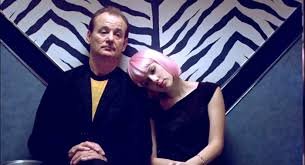
In the crowded landscape of early-2000s cinema, Lost in Translation emerges as a quietly radical study of dislocation and intimacy. Sofia Coppola’s film doesn’t chase spectacle; it pursues something far subtler: the emotional resonance of isolation in a hyperconnected world. Against the neon-lit labyrinth of Tokyo, Lost in Translation transforms loneliness into a shared, almost sacred language , a meditation on connection that is as gentle as it is haunting.
For Coppola, this is both a continuation and a refinement of the sensibilities glimpsed in The Virgin Suicides. Where her debut filtered adolescence through melancholy and longing, Lost in Translation filters adulthood through dislocation and quiet longing, capturing the liminal spaces of identity and intimacy. Unlike the narrative-driven dramas of the era, Coppola’s film privileges mood and interiority, drawing comparisons to Her in its exploration of unconventional connections and the unspoken spaces between people. Yet while Spike Jonze’s work leans on technological speculation, Coppola remains grounded in the tactile the warmth of a hotel room, the clatter of city streets, the intimacy of shared silences.
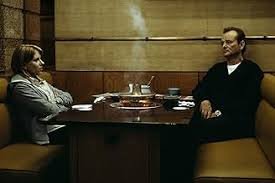
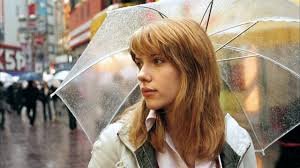
At the heart of the film is Bill Murray as Bob Harris, a washed-up actor trapped in a marital and professional malaise. Murray’s performance is a masterclass in restraint. His timing, the subtlest inflections of vocal tone, and the measured pauses in his body language convey an ocean of feeling without ever overstating it. He is weary, but alert; disconnected, yet desperate for small sparks of meaning. Opposite him, Scarlett Johansson’s Charlotte navigates her own existential limbo with an equally meticulous subtlety. Her posture, gaze, and tonal shifts articulate a young woman adrift, negotiating the invisible boundaries of social and emotional isolation. The chemistry between Murray and Johansson is not performative charm; it is the alchemy of careful observation and mutual recognition, making their fleeting connection both believable and heartbreakingly intimate.
Cinematographer Lance Acord’s work is essential to the film’s quiet power. His use of natural light and soft focus imbues Tokyo’s bright, impersonal spaces with warmth, creating a visual language that mirrors the characters’ internal states. Scenes linger just long enough for the emotional subtext to settle, and framing often positions the characters slightly off-centre, reinforcing their dislocation and the tentative nature of their connection.
The editing, by Sarah Flack, is deliberately unobtrusive. Long takes allow moments to breathe, particularly those that hinge on silence or subtle gestures. Coppola’s direction ensures that rhythm and pacing mimic the ebb and flow of emotional awareness, the small lulls, sudden sparks, and lingering uncertainties of human connection. Complementing this, the score featuring contributions from Kevin Shields alternates between ethereal melancholy and restrained, meditative tones, never imposing sentiment but enhancing the film’s reflective texture.
Beneath its aesthetic polish, Lost in Translation is fundamentally about the universality of isolation and the unspoken dimensions of human relationships. The film contemplates the spaces between generations, cultures, and even emotional states, revealing that connection often exists not in overt declarations but in shared understanding and attention. Coppola explores these themes without overt moralising, offering instead a nuanced meditation on loneliness, cultural dislocation, and the quiet impact of empathy.
The tonal balance is delicate. The film risks sliding into sentimentality or trivialising melancholy, but Coppola’s exacting control ensures the emotional payoff is earned, not manufactured. Moments of humour often derived from cultural dissonance or Bob’s understated bemusement punctuate but never undermine the film’s core contemplative quality.
Lost in Translation achieves its effect precisely by resisting the narrative grandiosity common in contemporaneous dramas. Its power emerges from the cumulative impact of small, carefully observed moments: a shared drink, a whispered joke, a long, contemplative gaze. Coppola’s confidence in stillness and restraint makes the eventual intimacy between Bob and Charlotte feel both inevitable and fleeting a crystallisation of ephemeral human connection.
“If connection is rare, it is because it must be found in the quietest spaces between us.”
“The brilliance of Lost in Translation is not in what is said, but in what is carefully left unsaid.”
Ultimately, the film is a masterclass in mood, performance, and subtle storytelling. It transforms the alienation of urban life into a meditation on presence, offering viewers both reflection and resonance. Coppola has created a work that lingers, much like the emotions it evokes: delicate, haunting, and unforgettable.
Rating: ★★★★★
Should you watch it?
Yes, particularly if you value films that explore the fragile beauty of fleeting human connection with precision and empathy.