
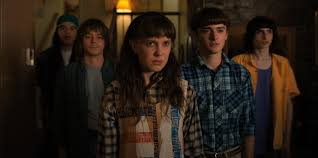
There is a particular kind of storytelling that doesn’t just revisit the past. It reconstructs it, polishes it, and then quietly interrogates why we wanted to return in the first place. Stranger Things operates within that tension. It arrives wrapped in the iconography of 1980s pop culture bikes, basements, synths, but its real subject is not nostalgia itself. It is the emotional architecture beneath it: fear, friendship, and the fragile belief that the world can still be understood, even when it fractures.
Created by The Duffer Brothers, Stranger Things positions itself at the intersection of homage and reinvention. Its influences are unmistakable E.T. the Extra-Terrestrial, The Goonies, and the shadow of Stephen King loom large, but the series distinguishes itself by weaving these references into a coherent emotional framework. It is not content to replicate tone or aesthetic; it seeks to reinterpret them through a contemporary lens, where innocence is less a given than a temporary condition under threat.
From its opening season, Stranger Things signals a confident synthesis rather than a risky departure. It does not attempt to dismantle genre conventions, but to refine them, combining supernatural horror, coming-of-age drama, and small-town mystery into a narrative that feels both familiar and immediate. In this sense, it shares DNA with Twin Peaks, though it trades that show’s surreal ambiguity for a more accessible emotional clarity.
At the centre of this world is Eleven, portrayed by Millie Bobby Brown in a performance that relies as much on silence as speech. Brown’s work is defined by restraint, subtle shifts in expression, a physical stillness that suggests both vulnerability and latent power. Her vocal delivery, when it emerges, carries a deliberate hesitancy, reinforcing the sense of a character learning not just language, but identity. It is a performance that anchors the series’ more fantastical elements in something recognisably human.
Around her, the ensemble cast operates with a naturalistic ease that recalls the group dynamics of The Goonies, yet feels less performative. Finn Wolfhard, Gaten Matarazzo, and Caleb McLaughlin bring a loose, conversational rhythm to their roles, their timing and delivery capturing the awkward sincerity of adolescence. Meanwhile, Winona Ryder and David Harbour ground the narrative in adult anxiety. Ryder’s performance, particularly in early seasons, is marked by a heightened emotional intensity, her vocal pitch and physical urgency conveying a mother on the edge of collapse, while Harbour’s Hopper evolves through controlled physicality, his posture and movement reflecting a man weighed down by past trauma.
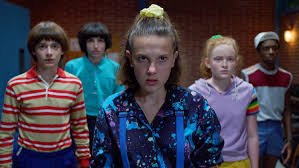
Technically, Stranger Things is a model of cohesive design. Its cinematography leans into warm, nostalgic tones, punctuated by stark contrasts when the narrative crosses into the Upside Down. The use of practical lighting, lamps, flashlights, and Christmas lights, creates a tactile sense of space, reinforcing the show’s grounding in physical environments even as it explores otherworldly dimensions. Camera movement is measured, often favouring slow pushes and lateral tracking shots that build tension without drawing attention to themselves.
Editing plays a crucial role in balancing the series’ multiple storylines. Cross-cutting between groups of characters allows the narrative to maintain momentum while emphasizing thematic parallels, different characters confronting variations of the same underlying threat. This structure becomes more pronounced in later seasons, occasionally to the point of fragmentation, but it remains an effective tool for managing scale.
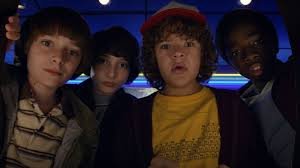
Production design is where Stranger Things most visibly embraces its nostalgic identity. Every detail from arcade cabinets to suburban interiors is meticulously curated, creating a world that feels both specific and idealised. Yet this attention to detail is not merely decorative; it reinforces the show’s central tension between safety and intrusion. The familiar becomes uncanny when disrupted, a theme echoed in the design of the Upside Down, which mirrors the real world in distorted, decaying form.
The score, composed by Kyle Dixon and Michael Stein, is integral to the series’ identity. Its synthesiser-driven soundscape evokes the era while maintaining a sense of unease, blending nostalgia with foreboding. The music does not simply accompany the narrative; it shapes its emotional texture, guiding the viewer through shifts in tone with subtle precision.
Beneath its genre trappings, Stranger Things is fundamentally about connection, the bonds that sustain individuals in the face of incomprehensible forces. It explores how friendship, family, and community function as forms of resistance, even when they are imperfect or strained. The supernatural elements serve as externalisations of internal fears: isolation, loss, and the transition from childhood to adulthood. In this, the series aligns with the thematic concerns of E.T. the Extra-Terrestrial, though it introduces a darker, more persistent sense of threat.
However, the series’ success is also the source of its challenges. As Stranger Things expands in scope, it risks diluting the intimacy that defined its early seasons. Narrative threads multiply, stakes escalate, and the balance between character and spectacle becomes harder to maintain. Later instalments occasionally lean too heavily on nostalgia as a substitute for innovation, recycling familiar beats rather than evolving them. The tension between homage and originality, once a strength, can begin to feel like a constraint.
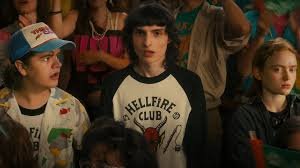
Yet even at its most uneven, Stranger Things retains a core emotional authenticity. It understands that its true power lies not in its monsters or mysteries, but in its characters, their relationships, their vulnerabilities, their capacity for growth. Watching the series is less about uncovering what happens next than about witnessing how these connections endure under pressure.
“Stranger Things transforms nostalgia into something more than memory, it becomes a language for fear and belonging.”
“Its greatest trick isn’t opening portals to other worlds, but reminding us how fragile our own can be.”
In the end, Stranger Things succeeds because it recognizes that the past is not a refuge, but a foundation, one that can be revisited, reimagined, and, ultimately, redefined.
Rating:★★★★☆(4/5)
Should you watch it? Yes, especially if you enjoy character-driven sci-fi horror that blends emotional depth with atmospheric storytelling.