
This blog contains affiliate links, meaning we may earn a small commission if you click through and make a purchase at no additional cost to you.
In 2026, Project Hail Mary, starring Ryan Gosling, brought Andy Weir’s bestselling novel to life on the big screen. The film follows Ryland Grace, a lone scientist-astronaut who wakes up on a distant spacecraft with no memory of his mission, only to discover he holds humanity’s last hope against a catastrophic solar threat. Blending high-stakes adventure with intricate scientific problem-solving, the movie has been celebrated as a standout in modern science fiction for its ability to combine thrilling storytelling with believable science. It reinvigorates the genre by showing that complex astrophysical concepts like interstellar travel, energy crises, and extra-terrestrial life can be both exciting and accessible to general audiences.
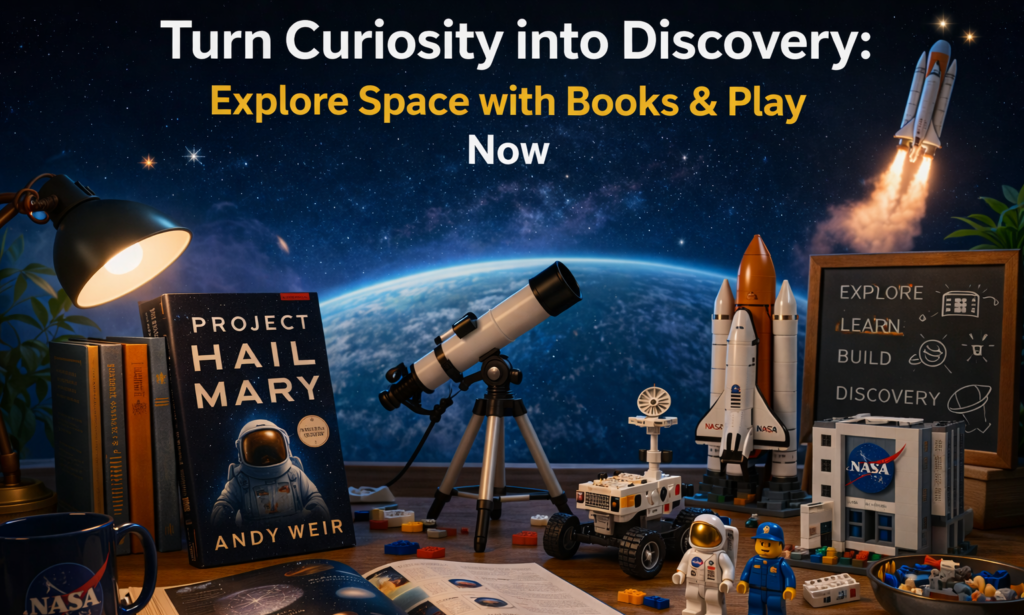
At its core, the film sparks a sense of wonder and curiosity about the universe. This curiosity naturally extends beyond the screen, encouraging viewers to explore space first-hand through tools like telescopes, which allow us to observe stars, planets, and other celestial phenomena, or through educational LEGO NASA sets, which bring the mechanics of space missions into tangible, hands-on play. By connecting imagination with real-world learning, Project Hail Mary becomes more than entertainment it acts as a bridge between storytelling and scientific exploration.
The intersection of imagination and tangible learning tools is where the film’s impact is most profound. Just as Ryland Grace solves impossible problems in deep space, viewers are inspired to explore, question, and create, whether by peering through a telescope or assembling a model rocket from LEGO bricks. In this way, the story ignites both wonder and active engagement with the science that underpins our understanding of the cosmos.
Project Hail Mary and Space Science
At the heart of Project Hail Mary is Ryland Grace’s mission to save humanity. Awakening alone aboard a distant spacecraft, he gradually recalls that his task is nothing short of monumental: to prevent a catastrophic solar phenomenon from extinguishing life on Earth. The film emphasizes the meticulous scientific problem-solving required for such a mission, Grace must analyse alien biology, devise engineering solutions with limited resources, and make high-stakes decisions under extreme pressure. This combination of suspense and science keeps viewers invested while highlighting the real intellectual challenges of space exploration.
Several themes run through the narrative, making it resonate beyond traditional sci‑fi. Isolation in space forces Grace to confront not only the vast emptiness of the universe but also the limits of human endurance. At the same time, his ingenuity and resilience showcase human creativity and the power of analytical thinking. The story also explores interstellar science and the possibilities of extraterrestrial communication, presenting a vision of collaboration that transcends species and planets, turning theoretical science into a narrative force.
One of the film’s strengths lies in its commitment to scientific accuracy. From the depiction of spacecraft mechanics and propulsion to the modelling of solar threats and the physics of interstellar travel, many concepts are grounded in current astrophysical understanding. Even the challenges of sustaining life aboard a spacecraft and the problem-solving required for long-duration missions reflect genuine scientific principles, making the story feel credible and immersive.
The broader impact of Project Hail Mary extends beyond entertainment. By presenting complex science in a compelling narrative, it inspires audiences to engage with astronomy, physics, and other STEM topics. Viewers are encouraged to look up at the night sky with curiosity, consider the engineering behind space missions, or explore hands-on models and simulations, creating a bridge between cinematic imagination and real-world scientific exploration.
Telescopes: Bridging Fiction and Reality
Telescopes serve as one of humanity’s most direct links to the cosmos, allowing us to observe stars, planets, and distant celestial phenomena in ways that mirror the observations depicted in Project Hail Mary. By bringing the universe into focus, telescopes transform abstract scientific concepts into tangible experiences, making the vastness of space more accessible and comprehensible.
The connection to the film is clear: Ryland Grace’s mission revolves around understanding and responding to a catastrophic solar event. Using a telescope, viewers can explore our own sun and its behavior, tracking sunspots, solar flares, or planetary motion, mirroring Grace’s investigative process on a real-world scale. Telescopes invite a form of scientific curiosity that simulates the problem-solving and observational skills he demonstrates, allowing enthusiasts to replicate a fraction of his explorations from their own backyard.
Engaging personally with a telescope also deepens appreciation for the complexity of space missions. Observing planetary orbits or distant stars fosters a tangible sense of scale and challenge, helping viewers grasp the engineering feats and precision required in Grace’s mission. The act of observing the night sky creates a bridge between cinematic storytelling and real-world astronomy, turning inspiration into action.
Beyond personal engagement, telescopes can serve as catalysts for STEM exploration. Young audiences exposed to Project Hail Mary may feel motivated to pursue astronomy, physics, or engineering, translating their fascination with space into potential careers. By linking the imaginative adventures of a sci-fi narrative with hands-on observation, telescopes help transform curiosity into learning and learning into lasting inspiration.
LEGO NASA Sets: Hands-On Exploration
LEGO NASA sets offer a hands-on gateway to space exploration, replicating spacecraft, space stations, and planetary missions with remarkable accuracy. These models allow builders to engage with the mechanics and design of real-world space technology, making abstract concepts tangible and interactive.
The connection to Project Hail Mary is particularly strong. By building and manipulating spacecraft models, viewers can better visualize Ryland Grace’s ship and the scientific instruments he relies on. This hands-on approach mirrors the problem-solving and spatial reasoning that astronauts and engineers must employ, offering a miniature simulation of the challenges Grace faces on his interstellar mission. LEGO sets provide a playful yet meaningful way to experiment with structure, mechanics, and design, core elements of astronautical engineering.
Beyond visualization, LEGO NASA sets carry significant educational value. They foster STEM learning through play, encouraging builders to explore engineering principles, physics, and creativity in an engaging, low-pressure environment. The process of assembling a spacecraft or modelling a mission reinforces teamwork, analytical thinking, and imaginative problem-solving, translating lessons from the film into actionable learning experiences. In this way, LEGO models serve as a bridge between cinematic inspiration and real-world scientific exploration, allowing audiences to not only imagine space missions but actively engage with the concepts behind them.
Integrating Film, Telescopes, and LEGO
The combined experience of watching Project Hail Mary, observing the night sky, and building LEGO NASA models creates a powerful experiential learning loop. First, the film sparks curiosity, immersing viewers in a high-stakes, scientifically grounded adventure that ignites the imagination. Next, using a telescope allows audiences to observe real celestial bodies planets, stars, and solar phenomena turning abstract concepts from the screen into concrete, personal experiences. Finally, building LEGO NASA models provides hands-on understanding of spacecraft design and mission planning, reinforcing the principles of engineering and problem-solving that underpin Grace’s journey.
This integration bridges fiction and reality, showing how narrative, observation, and tactile learning can work together to deepen scientific literacy. By combining imaginative storytelling with practical engagement, viewers are encouraged to explore space in multiple dimensions: intellectually, visually, and physically. Just as Ryland Grace relies on creative problem-solving to navigate the challenges of interstellar travel, audiences are inspired to experiment, question, and construct their own understanding of the cosmos. In this way, the story becomes more than entertainment it serves as a catalyst for learning, curiosity, and exploration.
Conclusion
Project Hail Mary sparks curiosity by turning complex scientific ideas into something vivid, urgent, and deeply human. Through its problem-solving narrative and relatable protagonist, it invites readers to think like scientists, asking questions, testing ideas, and embracing failure as part of discovery. That sense of wonder can naturally lead to greater interest in STEM, making science feel less like an abstract subject and more like an adventure waiting to be explored.
There’s real value in bridging stories like this with hands-on experiences. When media is paired with actual scientific tools or thoughtfully designed educational toys, the gap between imagination and understanding starts to close. Concepts that once felt distant, like astrophysics or chemistry, become tangible, something you can experiment with, build, and truly grasp. It transforms passive interest into active learning.
In the end, science fiction isn’t just a form of entertainment. It can open doors. It encourages curiosity, fuels creativity, and reminds us that learning doesn’t have to stay confined to textbooks. It can be playful, exploratory, and full of possibility, a starting point for discovery that extends far beyond the page.