
This blog contains affiliate links, meaning we may earn a small commission if you click through and make a purchase at no additional cost to you.
Over the weekend, my friends and I decided to watch Squid Game in a way I’d never tried before: with immersive headphones and smart lighting set to match the mood of each scene. What I thought would be a casual binge turned into an experience that felt almost cinematic, intense, immersive, and, honestly, unforgettable. Here’s how I did it, episode by episode, scene by scene.
Episode 1 : “Red Light, Green Light”
- Headphones: Surround sound, noise-cancelling mode.
- Lighting: Dimmed neutral white (about 20% brightness).
- Why: The mechanical doll and the eerie children’s song hit differently when isolated. The dim white light kept the room quiet and shadowy, letting every misstep feel amplified. I found myself holding my breath as each player froze or fell, my pulse synced with the countdown.
Episode 3 : “Tug of War”
- Headphones: Spatial audio on. Positioning sound to feel overhead.
- Lighting: Soft red-orange, brightness 30–40%.
- Why: The ropes creaking, the collective shouts, and the tension of balance felt like it was surrounding me. The warm, tense lighting mirrored the stadium’s intensity, making every moment physically gripping.
Episode 5: “The Glass Bridge”
- Headphones: Bass-enhanced mode for footsteps and glass cracking.
- Lighting: Dim amber glow, around 15% brightness.
- Why: The suspense of stepping on fragile glass panels became visceral. Each footstep sounded magnified, and the amber light created deep shadows across the room. I could feel my own heart echo in the tension.
Episode 7 : “Marble Game”
- Headphones: Vocal clarity mode, capturing whispers and strategy murmurs.
- Lighting: Cool blue-white, 25% brightness.
- Why: The cold, calculating tension of the game was heightened. Every whisper felt intimate, every move suspenseful, and the blue lighting mirrored the clinical, almost sterile setting of the arena. It made me lean forward instinctively, fully caught up in the moment.
Episode 9 : “Final Games”
- Headphones: Full immersive mode, balancing footsteps, crowd murmurs, and music.
- Lighting: Gradually shifting between red (for tension) and dim white (for relief), brightness 30–50%.
- Why: The finale is a rollercoaster of suspense and emotion. The shifting light mirrored the changing stakes, while the headphones placed me right in the middle of every sound, footsteps, sighs, and sudden silences. By the end, I felt like I’d been inside the arena myself.
Watching Squid Game like this changed everything. The headphones didn’t just amplify sound, they made me part of the story. The smart lighting wasn’t decoration; it shaped my emotional journey, guiding me through suspense, relief, and shock. Together, they transformed my living room into a tense, cinematic world that I felt rather than just watched.
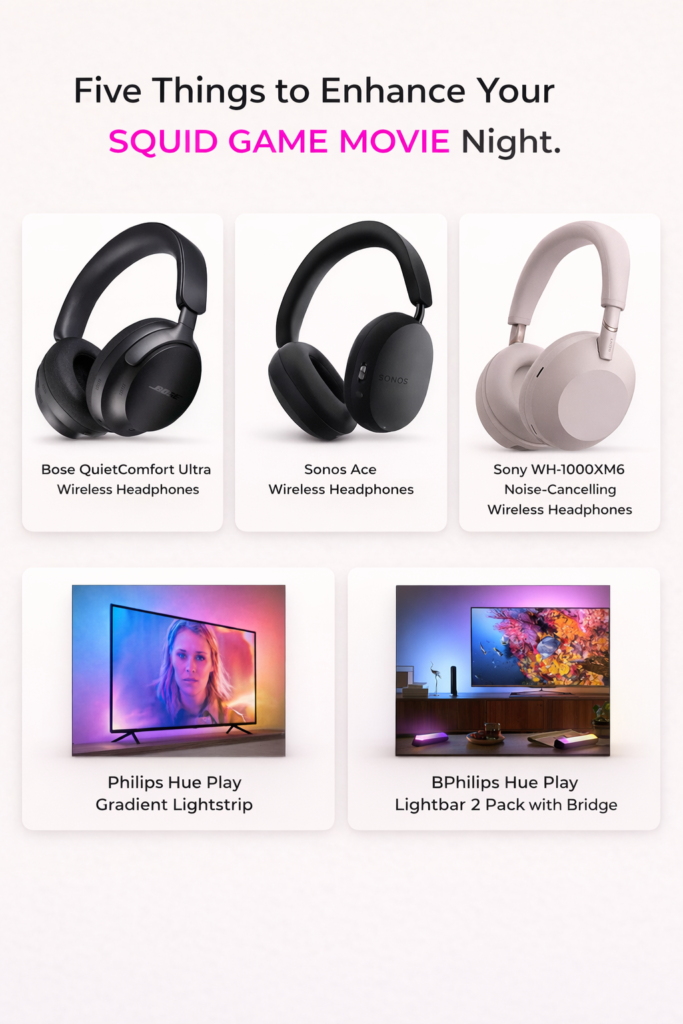
If you’re curious, I’ve linked the immersive headphones and smart lighting I used here, along with two options depending on your budget.
Immersive Audio Options
- Sony WH-1000XM6 Noise‑Cancelling Wireless Headphones: Excellent all‑around headphones with deep spatial sound and advanced noise cancellation. Great for tense scenes where every footstep and subtle cue counts.
- Sonos Ace Wireless Headphones: Premium wireless option with rich audio and comfort for long watches, making late‑night viewing feel focused and enveloping.
- Bose QuietComfort Ultra Wireless Headphones: Bose’s high‑end headphones blend comfort and powerful sound, so you stay immersed even during quiet, suspenseful moments.
Smart Lighting for Atmosphere
- Philips Hue Play Gradient Lightstrip – A popular choice for ambient lighting behind your screen that can adapt colours to your mood or scene, enhancing tension or warmth in real time.
- Philips Hue Play Lightbar 2 Pack with Bridge – A more complete set for syncing lighting throughout your room; works seamlessly with the Philips Hue ecosystem to match your on‑screen action.
They’re subtle tools, but they make a night of Squid Game unforgettable. You can turn each scene into a fully sensory experience without leaving your sofa.
Even after the screen goes dark, the echo of sound and shifting light lingers. I’m left with the quiet thrill that maybe, just maybe, this is how stories were meant to be experienced, not just seen, but felt.