

This blog contains affiliate links, meaning we may earn a small commission if you click through and make a purchase at no additional cost to you.
Few games capture the paradox of open-world fantasy as vividly as Dragon’s Dogma: Dark Arisen. Beneath its veneer of dragons, dungeons, and dynamic combat lies a meditation on agency, consequence, and companionship. Capcom’s reimagining of the original Dragon’s Dogma in the form of Dark Arisen is not merely an expansion. It is a refinement, a game that deepens narrative texture while doubling down on the mechanical boldness that initially startled the action-RPG landscape. For players seeking a world that reacts to their choices with both subtlety and ferocity, this is a title that demands attention.
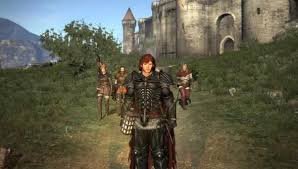
Director Hideaki Itsuno, whose work includes the Devil May Cry series, leverages a keen understanding of high-octane action to create a world where physics, AI, and player skill converge seamlessly. Unlike contemporaries like The Witcher 3: Wild Hunt, which prizes branching dialogue and cinematic story beats, Dark Arisen prioritises a tactile, emergent experience. Its combat is kinetic, demanding both strategy and reflex: climbing a griffin mid-flight or grappling a cyclops requires timing, patience, and risk assessment. In this respect, it aligns more closely with Monster Hunter: World in its attention to environmental interaction and combat choreography, but the philosophical undertones of destiny and morality imbue it with an identity uniquely its own.
The Pawn system is the game’s most singular innovation, and it elevates performance and characterisation to an often-overlooked artistry. Players craft a central companion, and the AI-driven Pawns learn, adapt, and react with uncanny precision. The lead Pawn may not have the emotive nuance of a motion-captured protagonist, but in the interplay of timing, positioning, and tactical support, it becomes a performer. Observing a Pawn anticipate an enemy’s charge or coordinate a flanking manoeuvre is a choreography of emergent intelligence that rewards observation as much as button mastery. It is this system that turns repetitive grind into cooperative strategy and lends a subtle emotional resonance to companionship, a rare achievement in an otherwise combat-heavy RPG.
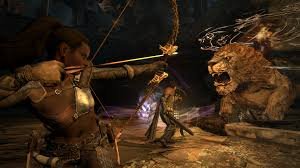
Technically, Dragon’s Dogma: Dark Arisen is both ambitious and occasionally flawed. The cinematography is functional rather than ornate, but it is the animation that impresses: every swing of a sword or arc of a bow carries discernible weight, every leap onto a towering drake feels grounded in physics. Editing maintains a taut rhythm during battle, alternating between high-stakes tension and necessary narrative reprieves. Production design is uneven; urban centres feel convincingly lived-in, while some wilderness regions verge on generic. The score, composed by Tadayoshi Makino, resonates during combat with percussive drive and soars with sweeping motifs in exploration sequences, underlining the game’s thematic tension between mortal vulnerability and heroic ambition.
Beneath the surface, Dark Arisen is a reflection on freedom, mortality, and the ethics of power. The narrative is deceptively simple: a hero confronts a dragon and the consequences of a stolen heart, but each encounter and moral choice probes questions of loyalty, vengeance, and the cost of ambition. The game’s optional dungeons and side quests expand this contemplation, presenting moral ambiguities and unexpected outcomes that challenge assumptions about heroism. Unlike many fantasy RPGs that reward linearity and predictability, Capcom’s design ensures that risk carries weight and that the world is never merely decorative.
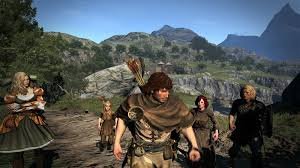
Playing Dragon’s Dogma: Dark Arisen is an experience defined by tension, flexibility, and tactile delight. Combat is fast, occasionally punishing, and always rewarding. Exploration invites improvisation, whether it’s scaling a cliff to ambush a wyvern or navigating treacherous caverns for hidden treasures. Pacing is variable, with lulls in dialogue and town life providing contrast to ferocious monster encounters. The game risks mechanical monotony, particularly in extended dungeon runs, but the combination of strategic combat and emergent interactions with Pawns offsets potential fatigue.
Within the genre, Dark Arisen stakes a singular claim. Where Dragon Age: Inquisition emphasises dialogue, politics, and narrative scaffolding, and Monster Hunter: World celebrates procedural precision, Capcom merges the two, creating an open-world RPG that is both reactive and viscerally engaging. Its systems reward player ingenuity, its world reacts credibly, and its combat delivers a satisfying combination of chaos and control.
Ultimately, Dragon’s Dogma: Dark Arisen is a triumph of design ambition and emergent storytelling. It is a reminder that open-world RPGs can challenge not just reflexes but imagination, and that the bonds between characters, human or AI, can shape narrative as much as scripted cutscenes. It is visceral, occasionally uneven, and always compelling, rewarding players willing to engage deeply with its mechanics and moral landscapes.
★9/10
A bold, kinetic fantasy epic that blends emergent AI, dynamic combat, and contemplative world-building into a singularly unforgettable adventure.