

Some films age into irrelevance, their cultural moment sealed off like a time capsule. And then some films quietly evolve alongside their audience, revealing new layers with each passing year. Legally Blonde belongs decisively to the latter. What once appeared to be a glossy studio comedy has, over time, clarified itself as something sharper, more subversive, and unexpectedly enduring.
Released in 2001 and directed by Robert Luketic, Legally Blonde arrived as a bold tonal gamble, a studio comedy that dared to centre femininity without apology, and intelligence without austerity. It neither mocked its heroine nor demanded she transform to earn respect. Instead, it reframed the terms entirely. In hindsight, it plays less like a lightweight diversion and more like a quiet act of cultural recalibration.

Context & Positioning
At the turn of the millennium, Hollywood comedies often leaned on irony or broad caricature, particularly when portraying ambitious women. Within that landscape, Legally Blonde stood apart. Backed by Metro-Goldwyn-Mayer, the film arrived during a period when mid-budget, star-driven comedies were still central to the industry’s identity.
Comparisons to Clueless are inevitable, but instructive. While Clueless revelled in satire, Legally Blonde rejects distance; it treats its protagonist’s worldview as fundamentally valid. Similarly, where The Devil Wears Prada frames female ambition through a lens of compromise and cost, Legally Blonde proposes something more radical: that success and selfhood need not be mutually exclusive.
This is where the film distinguishes itself. It doesn’t deconstruct the “blonde stereotype” so much as dismantle the assumptions surrounding it. That distinction matters, and it’s a key reason the film has endured.
Character & Performance Analysis
The film’s lasting impact begins and ends with Reese Witherspoon. Her portrayal of Elle Woods is a study in precision disguised as ease. Witherspoon calibrates every element of the performance, vocal inflection, posture, timing to create a character who is both heightened and entirely believable.
Her vocal work is particularly notable. Elle’s bright, almost musical cadence could easily tip into parody, but Witherspoon anchors it with emotional clarity. When the tone shifts, when confidence gives way to doubt, the modulation is subtle but unmistakable. She doesn’t abandon the character’s surface qualities; she deepens them.
Physically, Witherspoon uses movement to signal growth. Early scenes emphasise buoyancy and openness, quick steps, expansive gestures, while later moments introduce stillness and control. It’s a performance built not on transformation, but on refinement.
Supporting performances are equally deliberate. Laura Dern brings a measured authority to Professor Stromwell, her restrained delivery serving as a counterpoint to the film’s brighter energy. Luke Wilson, as Emmett, operates with a quiet steadiness, his understated presence grounding the narrative without demanding attention.
Meanwhile, Selma Blair navigates a more complex tonal space. Her performance as Vivian begins with controlled rigidity, tight posture, clipped speech, before gradually softening. The shift is not dramatic, but it is precise, reflecting a character whose worldview is being carefully, reluctantly expanded.
Craft & Technical Evaluation
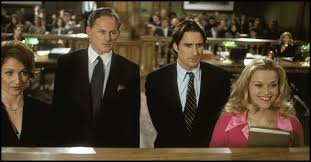
Visually, Legally Blonde embraces a bright, high-key aesthetic that mirrors its protagonist’s perspective. Cinematographer Anthony B. Richmond uses clean compositions and saturated colour to create a world that feels both heightened and accessible. The contrast between Elle’s vibrant palette and Harvard’s muted tones is not subtle, but it is effective, an externalisation of the film’s central tension.
Editing plays a crucial role in maintaining tonal balance. The rhythm is brisk without feeling rushed, allowing comedic beats to land while keeping the narrative in constant motion. Transitions are often motivated by character rather than plot, reinforcing the film’s focus on personal evolution.
Production design further supports this approach. Elle’s spaces are defined by texture and colour, soft fabrics, warm lighting, while institutional settings lean toward symmetry and restraint. The visual language is clear: individuality versus conformity, expressed not through dialogue, but through environment.
The score, light and unobtrusive, avoids overpowering the film’s energy. Instead, it works in tandem with the dialogue, accentuating shifts in tone without dictating them. This restraint allows performances to remain at the forefront.
Theme & Subtext
Beneath its polished surface, Legally Blonde is a film about perception, how it is formed, how it is weaponized, and how it can be reclaimed. Elle Woods is not underestimated because she lacks ability, but because she embodies qualities that are culturally coded as trivial.
The film’s subversion lies in its refusal to strip those qualities away. Elle does not become less feminine, less optimistic, or less herself in order to succeed. Instead, she demonstrates that these traits are not limitations, but strengths when properly understood.
There is also a quiet critique of institutional gatekeeping. Harvard, as depicted in the film, is less a place of intellectual rigor than a space governed by unspoken rules about who belongs. Elle’s presence disrupts those rules, not through rebellion, but through persistence.
Importantly, the film resists the urge to frame this disruption as singular. It’s not just about Elle proving others wrong; it’s about expanding the definition of competence itself.
Tone & Audience Experience
Watching Legally Blonde is an exercise in tonal precision. The film moves effortlessly between comedy and sincerity, rarely lingering long enough in either mode to feel unbalanced. Its pacing is one of its greatest strengths; scenes unfold with a sense of momentum that mirrors Elle’s own forward motion.
There are moments where the film edges toward oversimplification. Certain conflicts resolve more cleanly than reality might allow, and some secondary characters are sketched rather than fully developed. Yet these choices feel consistent with the film’s broader aims. It is not striving for realism; it is constructing a framework in which its themes can resonate clearly.
“Legally Blonde doesn’t just challenge stereotypes; it exposes how flimsy they were to begin with.”
“Its brilliance lies in refusing to trade identity for acceptance.”
Legally Blonde Explained: Plot, Cast, and Why It Still Inspires
At a glance, Legally Blonde follows a deceptively simple arc: Elle Woods, a seemingly superficial sorority president, enrols at Harvard Law School to win back a boyfriend and instead discovers her own intellectual and emotional authority. But the film’s staying power lies in how it reframes that journey, not as a transformation, but as recognition. Anchored by Reese Witherspoon’s finely tuned performance, the ensemble, including Laura Dern and Luke Wilson, constructs a world where charm, empathy, and acuity coexist. It inspires because it refuses the tired equation of seriousness with severity, offering instead a portrait of intelligence that is expansive, inclusive, and quietly radical.
Why Legally Blonde Redefined the Modern Female Comedy
Legally Blonde didn’t merely succeed within the female-led comedy space, it recalibrated it. Where earlier films often positioned women as either aspirational or satirical figures, this film collapses that binary. Elle Woods is neither a punchline nor a pedestal; she is a fully realised protagonist whose femininity is neither diluted nor weaponised against her. In doing so, the film shifted the genre’s centre of gravity, making space for stories that celebrate competence without cynicism and humour without condescension. Its influence can be traced in the tonal confidence of later comedies, but few have matched its clarity of purpose.
The Lasting Impact of Legally Blonde on Pop Culture and Feminism
The cultural footprint of Legally Blonde extends far beyond its runtime. It reshaped the “dumb blonde” trope into something self-aware and ultimately unsustainable, exposing its underlying assumptions rather than merely subverting them. Within feminist discourse, the film occupies a nuanced position, less overtly political than declarative, yet no less significant for it. It argues, through example rather than manifesto, that empowerment need not reject traditionally feminine aesthetics or behaviours. In an era increasingly attentive to representation, its message feels not only intact, but newly resonant.
Legally Blonde Movie Review: Why Elle Woods Still Wins Hearts
Elle Woods endures because she is constructed with an unusual degree of generosity. Reese Witherspoon plays her with a balance of precision and openness, every gesture deliberate, every line delivered with a rhythm that suggests both confidence and curiosity. The performance invites empathy without demanding it, allowing audiences to arrive at admiration organically. More importantly, Elle’s victories are never framed as exceptional; they are presented as the natural result of qualities that were visible all along. That insistence, that she was always enough, is what continues to resonate.
From Fashion to Law: What Legally Blonde Teaches About Confidence
One of Legally Blonde’s most quietly subversive achievements is its refusal to treat style and substance as opposites. Elle’s fluency in fashion is not a distraction from her legal acumen; it is an extension of the same attentiveness and discipline. The film suggests that confidence is not the absence of perceived frivolity, but the integration of all aspects of the self. By allowing its protagonist to succeed without shedding her identity, it reframes confidence as something rooted in authenticity rather than adaptation.
Legally Blonde Cast Then and Now: Where Are They Today?
The film’s ensemble has, in many ways, mirrored its enduring relevance. Reese Witherspoon has evolved into a formidable industry presence, balancing acclaimed performances with influential production work. Laura Dern has continued a career marked by critical recognition, while Luke Wilson and Selma Blair have sustained varied and distinctive screen presences. Their trajectories underscore the film’s position not as a fleeting success, but as a foundational moment in early-2000s cinema.
How Reese Witherspoon Made Legally Blonde Iconic
It is difficult to imagine Legally Blonde without Reese Witherspoon, not simply because she leads it, but because she defines its tonal architecture. Her performance operates on a knife’s edge, bright without being brittle, earnest without slipping into sentimentality. She understands that Elle’s strength lies in consistency, not reinvention, and calibrates her portrayal accordingly. The result is a character who feels both heightened and authentic, a balance that transforms a high-concept premise into something enduringly human.
Legally Blonde Quotes, Lessons, and Moments That Still Matter
The film’s most memorable lines and scenes persist not because they are catchy, but because they distil its central ideas with clarity. Moments that could have played as simple comedic beats instead function as thematic anchors, reinforcing the film’s commitment to self-definition and resilience. Its dialogue carries a lightness that belies its precision; beneath the wit lies a consistent argument about worth, perception, and the courage to remain unchanged in the face of expectation.
Is Legally Blonde Worth Watching in 2026? A Fresh Review
More than two decades after its release, Legally Blonde remains remarkably intact. Its pacing, performances, and thematic focus feel neither dated nor diminished, in part because its central concerns, identity, ambition, and perception, are perennial. If anything, its optimism reads as increasingly rare, offering a form of storytelling that is both accessible and quietly assertive. In 2026, it doesn’t feel like a relic; it feels like a reminder of how effective clarity, charm, and conviction can be when they align.
Critical Judgment
To call Legally Blonde a “feel-good movie” is accurate, but insufficient. It is also a carefully constructed piece of storytelling that understands the power of tone, performance, and perspective. Its influence can be traced across two decades of film and television, yet few have replicated its balance of charm and clarity.
The film’s flaws, occasional predictability, and reliance on familiar genre beats are real, but ultimately minor. They do not undermine its central achievement, which is to create a narrative that feels both entertaining and quietly transformative.
In a genre often dismissed as lightweight, Legally Blonde asserts itself with confidence. It doesn’t demand to be taken seriously; it earns that seriousness through execution.
Conclusion
Legally Blonde endures because it understands something fundamental: that identity is not something to be negotiated away, but something to be fully inhabited. It is a film that celebrates intelligence without cynicism, ambition without cruelty, and individuality without compromise.
More than two decades later, its message feels not dated, but necessary.
Rating: ★★★★☆
Should you watch it? Without hesitation, it remains one of the smartest comedies ever disguised as the lightest.
Cast & Credits:
- Director: Robert Luketic
- Cast: Reese Witherspoon, Luke Wilson, Selma Blair, Laura Dern
Where to Watch:
Available on platforms like Amazon Prime Video, Apple TV, and other major streaming services (availability may vary by region).