
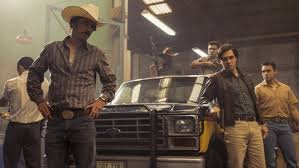
There is a dangerous allure in stories about empire, the rise, the excess, the illusion of invincibility before the inevitable fall. Narcos understands this allure intimately, and more importantly, it weaponised it. It invites the audience into a world of staggering wealth and ruthless ambition, only to steadily erode the fantasy, exposing the machinery beneath. This is not merely a crime saga; it is a study in systems, how they are built, how they sustain themselves, and how they collapse under the weight of their own contradictions.
Developed by Chris Brancato, Carlo Bernard, and Doug Miro, Narcos situates itself within the lineage of prestige crime television that includes Breaking Bad and The Wire. Yet where Breaking Bad narrows its focus to personal transformation and The Wire expands outward into institutional critique, Narcos occupies a volatile middle ground. It blends character study with historical reconstruction, using real-world events as both narrative framework and moral anchor. The result is a series that feels at once grounded and mythologised.
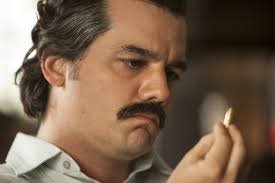
From its opening episodes, Narcos signals a dual ambition: to dramatise the rise of Pablo Escobar while simultaneously interrogating the forces that enabled him. This balancing act is its defining strength. The series does not merely chronicle Escobar’s ascent; it contextualises it within global demand, political instability, and the often contradictory role of U.S. intervention. In doing so, it resists the simplicity of hero-villain binaries, even as it occasionally flirts with them.
At the centre of the series is Escobar himself, portrayed by Wagner Moura with a performance that oscillates between intimacy and intimidation. Moura avoids caricature by grounding Escobar in physical specificity: a deliberate gait, a soft yet controlled vocal delivery, a gaze that can shift from paternal warmth to lethal calculation in an instant. His Escobar is not defined by volatility alone, but by an unsettling normalcy, the ability to move seamlessly between domestic tenderness and orchestrated violence.
Opposing him is Steve Murphy, played by Boyd Holbrook, whose narration frames much of the series. Holbrook’s performance is intentionally straightforward, almost to a fault, serving as a conduit for the audience’s perspective. Alongside him, Javier Peña brought to life by Pedro Pascaladds a layer of moral ambiguity. Pascal’s understated delivery and controlled physicality suggest a man increasingly aware of the compromises required by his role, even as he continues to operate within the system.
The supporting cast enriches the narrative with a range of perspectives, from cartel operatives to political figures, each contributing to the sense that this is not a story of individuals alone, but of networks interconnected, interdependent, and ultimately unstable.
Technically, Narcos distinguishes itself through a hybrid aesthetic that blends dramatised scenes with archival footage. This interplay between fiction and reality creates a sense of immediacy, grounding the narrative in historical texture while maintaining dramatic momentum. The cinematography favours a naturalistic approach, with handheld shots and muted colour palettes that evoke both documentary realism and narrative urgency.
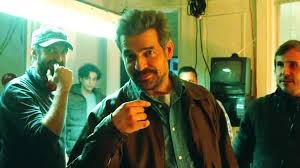
The editing rhythm is particularly effective in managing the series’ dual timelines and shifting perspectives. Rapid cross-cutting between locations in Colombia, the United States, and various points in between reinforces the global scale of the drug trade. This approach mirrors the complexity of the systems being depicted, where actions in one place reverberate unpredictably in another.
Production design plays a crucial role in establishing authenticity. From the opulence of Escobar’s estates to the stark functionality of government offices, each environment is rendered with attention to detail. These spaces are not merely backdrops; they are expressions of power, control, and, ultimately, vulnerability.
Sound design and score further enhance the atmosphere, blending regional musical influences with more conventional dramatic scoring. The use of music is often strategic rather than constant, allowing silence and ambient noise to carry tension in key moments. This restraint prevents the series from tipping into melodrama, even as its subject matter invites it.
At its core, Narcos is about the economics of desire. It examines how demand, particularly from the United States, drives supply, creating a cycle that no single individual can control. Escobar may be the face of the operation, but he is also a product of it, shaped by forces that extend far beyond his immediate environment. This thematic focus aligns the series with The Wire, though Narcos approaches its subject with a more overt sense of narrative propulsion.
Yet the series is not immune to critique. Its reliance on narration, while effective in establishing context, can occasionally feel reductive, simplifying complex dynamics into digestible explanations. At times, the show risks glamorizing the very figure it seeks to interrogate, particularly in its early seasons, where Escobar’s charisma can overshadow the brutality of his actions. The balance between critique and fascination is delicate, and Narcos does not always maintain it.
Still, these tensions are part of what makes the series compelling. It is not a detached analysis, but an engaged, sometimes contradictory exploration of power and consequence. Watching Narcos is an exercise in dual awareness being drawn into the spectacle while simultaneously recognizing its cost.
“Narcos doesn’t just chart the rise of a kingpin, it maps the ecosystem that made him inevitable.”
“Its greatest insight is that power, once accumulated, rarely collapses alone.”
In the end, Narcos leaves the viewer with a lingering unease. It suggests that the forces it depicts, greed, demand, and institutional compromise are not confined to a particular time or place. They are systemic, persistent, and, perhaps most unsettlingly, familiar.
Rating:★★★★☆(4/5)
Should you watch it? Yes,especially if you’re drawn to historically grounded crime dramas that balance character study with broader socio-political insight.