
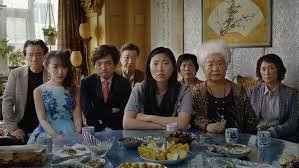
In an age that prizes radical transparency confession as currency, honesty as a moral imperative. The Farewell dares to suggest something quietly subversive: that love can sometimes take the shape of a lie. Lulu Wang’s film is not simply a cross-cultural dramedy; it is a carefully observed meditation on the ethics of care, one that frames deception not as betrayal, but as collective protection. The result is a work of striking emotional intelligence, a bold, deeply personal statement that feels both culturally specific and universally resonant.
For Wang, The Farewell represents a breakthrough rather than a return, a crystallisation of voice that places her firmly within a lineage of filmmakers exploring diasporic identity and familial tension. Yet where films like Crazy Rich Asians lean into spectacle and romantic fantasy, and Minari finds poetry in immigrant struggle, The Farewell occupies a more intimate, morally ambiguous terrain. Its closest tonal cousin may be Tokyo Story, not in plot but in sensibility, a shared attentiveness to generational distance, and to the quiet heartbreak embedded in ordinary interactions.
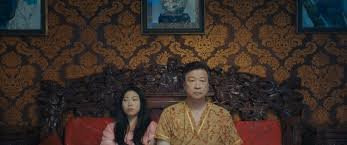
At the centre is Awkwafina, whose performance as Billi is defined by restraint and recalibration. Known largely for comedic roles, she here strips away performative energy, replacing it with a watchful stillness. Her technique is rooted in reaction rather than action. Billi listens often more than she speaks, and Awkwafina allows meaning to register in micro-expressions: a tightening around the eyes, a delayed response, a voice that hovers between defiance and vulnerability. The performance is built on hesitation, on the sense of someone constantly editing herself in real time.
Opposite her, Zhao Shuzhen delivers a performance of remarkable warmth and precision as Nai Nai. There is nothing overtly sentimental in her approach. Instead, Zhao relies on the rhythm and cadence of her speech, the gentle insistence of her gestures to convey a life fully inhabited. Her presence anchors the film, not as a symbol, but as a person whose vitality complicates the very premise of the lie surrounding her.
The ensemble, including Tzi Ma and Diana Lin, operates with a finely tuned sense of collective tension. Conversations are layered with subtext, pauses carrying as much weight as dialogue. What emerges is not a series of individual performances, but a shared emotional ecosystem, one in which each character negotiates their own relationship to truth, obligation, and grief.
Formally, The Farewell mirrors this restraint. Cinematographer Anna Franquesa Solano employs a visual language that is both composed and quietly expressive. Frames are often symmetrical, even static, emphasising the social structures that govern the characters’ behaviour. Interiors, hotel rooms, family apartments, banquet and halls are rendered with a subdued palette that reflects both familiarity and confinement. The camera rarely intrudes; instead, it observes, allowing tension to accumulate within the frame.
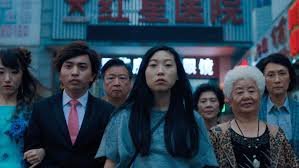
The editing follows a similarly measured rhythm. Scenes are allowed to breathe, often extending just beyond narrative necessity. This temporal generosity creates space for discomfort for the awkward silences and half-finished sentences that define the film’s emotional landscape. There is no rush toward revelation, no dramatic crescendo imposed from the outside. Instead, the film unfolds with the quiet inevitability of lived experience.
Sound design and music are used sparingly but effectively. Alex Weston’s score avoids manipulation, entering only when necessary, and even then with a light touch. More often, the film relies on ambient sound, the murmur of conversation, the clatter of dishes, the distant hum of a city to ground its emotional reality. This sonic minimalism reinforces the film’s central tension: the coexistence of the ordinary and the profound.
Beneath its surface, The Farewell is less about cultural difference than about competing philosophies of care. The oft-cited contrast between Eastern collectivism and Western individualism is present, but Wang resists reducing it to a binary. Instead, she explores how these frameworks shape emotional expression. For Billi, raised in the United States, truth is tied to autonomy, the belief that individuals have the right to know and decide. For her family in China, truth is subordinate to harmony, the idea that suffering can, and perhaps should, be distributed.
This tension is never resolved, nor should it be. The film’s strength lies in its refusal to adjudicate. It does not ask the audience to choose a side, but to sit within the discomfort of both. In doing so, it reveals a deeper truth: that love is often contradictory, capable of both clarity and obfuscation.
There is also an undercurrent of performance not in the theatrical sense, but in the everyday act of maintaining appearances. The family gathering at the film’s centre becomes a kind of collective staging, each participant playing a role designed to sustain the illusion. Yet within this performance, moments of authenticity break through: a glance held too long, a laugh that falters, a gesture that betrays what cannot be said. These ruptures are where the film finds its emotional power.
Watching The Farewell is an exercise in attunement. Its pacing is deliberate, its conflicts understated. It risks, at times, being mistaken for slightness. But this is a misreading. The film’s impact is cumulative, building through repetition and variation until its emotional weight becomes undeniable. It does not demand attention; it earns it, quietly but persistently.
If there is a limitation, it lies in the film’s occasional reliance on its central conceit. Certain scenes reiterate the same emotional beat without deepening it, creating a sense of thematic redundancy. Yet even here, Wang’s control of tone prevents the film from stagnating. The humour dry, situational, and often emerging from discomfort, providing a counterbalance, ensuring that the film never collapses under its own seriousness.
“Love, in The Farewell, is not declared it is managed, negotiated, and sometimes hidden in plain sight.”
“In choosing what not to say, the film reveals everything that matters.”
Ultimately, The Farewell stands as a film of rare sensitivity and clarity. It trusts its audience to navigate ambiguity, to recognise that emotional truth does not always align with factual truth. In doing so, it offers a perspective that feels both culturally grounded and philosophically expansive.
Wang has crafted a film that lingers not because of what it shows, but because of what it asks: what do we owe each other, and at what cost?
Rating: ★★★★½
Should you watch it? Yes, especially if you value films that trade spectacle for insight, and certainty for something far more human.