
This blog contains affiliate links, meaning we may earn a small commission if you click through and make a purchase at no additional cost to you.
To understand its achievement, it helps to situate it against both its lineage and its peers. The DNA of Dark Souls is everywhere: in the stamina-based combat, the cryptic NPCs, the sense of a civilisation long past its prime. But where Dark Souls was claustrophobic and labyrinthine, Elden Ring is expansive, almost defiantly so. It also invites comparison to The Legend of Zelda: Breath of the Wild, another title that reimagined open-world freedom as systemic rather than checklist-driven. Yet where Breath of the Wild emphasises player creativity and physical simulation, Elden Ring leans into dread and discovery, its landscapes less playground than graveyard.
What distinguishes Elden Ring most is how it reconciles scale with intentionality. The Lands Between are vast, but rarely feel padded. A ruined church glimpsed on the horizon often conceals a narrative fragment, a weapon, a corpse, a hint of betrayal that deepens the world’s mythology. Unlike the algorithmic sprawl of many open-world games, there is a tactile sense of authorship here. Every hill seems placed, every dungeon curated.
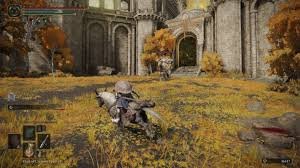
Combat, as ever in Miyazaki’s work, is where theory meets practice. Encounters demand not just reflexes, but discipline. Timing is measured in fractions of seconds; a poorly judged dodge or greedy attack is punished immediately. Yet Elden Ring subtly broadens the player’s expressive range. The introduction of Spirit Ashes, for instance, allows for tactical summoning, shifting the rhythm of battle without diluting its tension. Magic builds, stealth approaches, and mounted combat all feel viable, not ornamental.
Enemy design deserves particular attention. Bosses in Elden Ring are not merely difficult they are performative. Consider the towering figures that dominate the game’s late stages: their movements are choreographed with an almost balletic precision, alternating between languid feints and explosive violence. What makes these encounters memorable is not just their difficulty, but their readability. Animations telegraph intent with just enough clarity to reward attentive players, creating a dialogue between designer and participant.
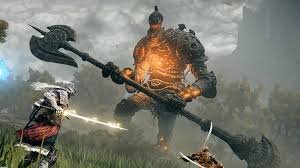
There is, too, a physicality to these confrontations that is easy to overlook. The weight of a greatsword swing, the stagger of a shield under impact, the slight delay before a colossal enemy recovers. These details accumulate into something approaching realism, even within a fantastical setting. It is not realism of appearance, but of consequence.
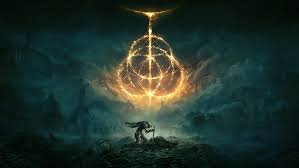
Technically, Elden Ring is less about spectacle than cohesion. Its visual design does not chase photorealism; instead, it leans into painterly composition. Golden fields stretch beneath a fractured sky, while distant castles loom like memories half-forgotten. The art direction recalls the gothic austerity of earlier FromSoftware titles, but introduces a broader palette of lush greens, radiant golds that suggest a world still clinging to life, however tenuously.
The game’s “camera,” if one can borrow cinematic terminology, is functional rather than expressive, but its framing often produces accidental beauty. Cresting a hill to reveal a vast valley, descending into a subterranean city lit by ghostly stars, these moments linger. They are not scripted set pieces so much as emergent vistas, discovered rather than delivered.
Sound design plays a quieter, but equally crucial role. Silence dominates exploration, broken only by wind, distant creatures, or the faint echo of footsteps. When music does arrive, typically during boss encounters, it swells with operatic intensity, reinforcing the sense that each battle is a kind of ritual. The contrast between these modes amplifies both.
Beneath its surface, Elden Ring is preoccupied with decay and ambition. Its narrative, fragmented and oblique, circles around the collapse of order and the cost of power. Characters cling to faded ideals or pursue dominance at any cost, their stories often ending in tragedy or transformation. There is a political dimension here, albeit understated: a meditation on succession, legitimacy, and the fragility of systems built on divine authority.
Yet the game resists easy interpretation. It offers symbols rather than statements, inviting players to assemble meaning from shards. This ambiguity is not evasive; it is generative. By refusing to dictate a singular reading, Elden Ring becomes a collaborative act between creator and audience.
What does it feel like to play? At its best, Elden Ring induces a state of heightened awareness. Exploration carries a constant undercurrent of risk; even routine encounters can escalate unexpectedly. There is frustration, certainly difficulty spikes that verge on excess, late-game areas that test endurance as much as skill, but these moments rarely feel arbitrary. More often, they serve as inflection points, forcing adaptation.
Pacing, however, is not without issue. The sheer scale of the game can dilute its impact over time. Repeated dungeon types and recycled bosses occasionally undercut the sense of discovery that defines its early hours. This is the cost of ambition: a world so large that it cannot always sustain its own density.
Still, these shortcomings feel marginal against the whole. Elden Ring succeeds not because it is flawless, but because its flaws are in service of something larger, a vision of what open-world design can be when guided by restraint rather than excess.
Two lines linger as encapsulations of its achievement:
“A world that does not ask to be conquered but understood.”
“An open-world epic that finds its grandeur not in scale, but in silence.”
In the end, Elden Ring stands as both culmination and provocation. It gathers a decade of design philosophy into a single, expansive form, while challenging the conventions that have come to define its genre. Few games in recent memory feel as assured in their identity, or as willing to trust the player’s intelligence.
Its legacy will not be measured solely in sales or accolades, but in the conversations it reshapes about difficulty, about storytelling, about the very structure of interactive worlds.
Rating: 9.5/10