
This blog contains affiliate links, meaning we may earn a small commission if you click through and make a purchase at no additional cost to you.
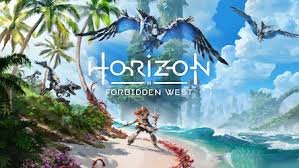
In blockbuster game design, spectacle has long been mistaken for substance. Worlds expand, budgets swell, and yet so often the experience feels curiously weightless, beautiful but inert. Horizon Forbidden West resists that fate with quiet determination. It is not a revolution, nor does it pretend to be. Instead, it is something rarer in today’s sequel-driven landscape: a refinement so assured, so meticulously crafted, that it transforms familiarity into depth.
This is, unmistakably, a maturation rather than a reinvention. Developed by Guerrilla Games and building on the foundation of Horizon Zero Dawn, Horizon Forbidden West represents a studio consolidating its strengths while cautiously extending its reach. If the original was a proof of concept, a striking fusion of tribal futurism and machine ecology, this sequel is the articulation of that concept at scale. It doesn’t abandon the formula; it interrogates it, polishes it, and, at times, deepens it in unexpected ways.
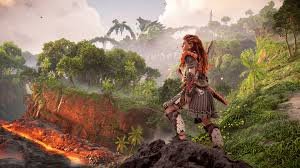
Placed within the broader genre, Horizon Forbidden West occupies an interesting middle ground. It lacks the systemic minimalism of The Legend of Zelda: Breath of the Wild, which redefined player freedom through physics-driven interaction, and it avoids the oppressive density of Assassin’s Creed Valhalla, where scale often overwhelms purpose. Instead, Guerrilla opts for a curated openness: a world that feels expansive but directed, filled with activities that are less about quantity than about variation and narrative context.
Where Horizon Forbidden West most clearly evolves is in its sense of place. The western frontier it depicts is not merely larger than its predecessor. It is more alive. Settlements feel inhabited rather than decorative; ecosystems exhibit a fragile coherence. Machines no longer seem like isolated threats but components of a broader, interconnected system. This shift, subtle but pervasive, grounds the game’s spectacle in a kind of ecological logic.
Central to that grounding is the performance of Aloy, once again voiced and motion-captured by Ashly Burch. Burch’s work here is notably more restrained than in the original. Where Aloy previously carried a certain blunt determination, she now exhibits a quieter, more reflective cadence. Lines are delivered with measured pacing, often trailing off into introspection rather than landing with declarative force. It’s a performance built on micro-adjustments slight hesitations, shifts in tone, that suggest a character increasingly aware of the burden she carries.
Supporting performances add texture without overwhelming the narrative. Lance Reddick, as the enigmatic Sylens, employs a controlled vocal precision that borders on surgical. His timing is deliberate, his pauses calculated, creating an aura of intelligence that feels both alluring and dangerous. Meanwhile, ensemble characters are given more room to breathe than before, their animations and vocal deliveries aligning more closely with cinematic standards. Conversations unfold with a rhythm that feels less transactional and more performative, aided by improved facial capture and staging.
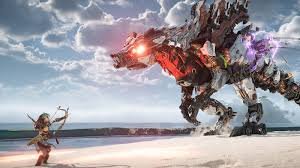
Technically, Horizon Forbidden West is a showcase of contemporary production craft. Its visual design leans into a saturated realism, where colour becomes a narrative tool. Lush jungles, sun-bleached deserts, and coral reefs rendered in astonishing detail are not merely backdrops; they are tonal shifts, each biome carrying its own emotional register. The animation system, particularly in combat, achieves a fluidity that reinforces both the game’s mechanical precision and its aesthetic coherence.
There is a cinematic sensibility to how the game frames its world. Camera movement during traversal is unobtrusive but purposeful, allowing vistas to emerge organically. In dialogue scenes, subtle shifts in framing close-ups that linger just a moment longer than expected, over-the-shoulder angles that emphasise distance between characters add a layer of visual storytelling that was largely absent in the first instalment.
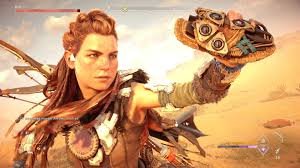
Sound design operates with similar intentionality. The mechanical creatures emit a range of auditory cues that function as both atmosphere and gameplay feedback, their metallic groans and electronic pulses signalling behaviour patterns. The score, composed by Joris de Man and collaborators, blends orchestral elements with synthetic textures, mirroring the game’s thematic tension between nature and technology. Music swells not to overwhelm but to underline, often receding into near-silence during exploration before reasserting itself in moments of heightened tension.
Beneath its polished surface, Horizon Forbidden West is preoccupied with legacy who inherits the future, and at what cost. Its narrative threads, while occasionally diffuse, circle around questions of stewardship and control. The world it depicts is one shaped by past failures, its present inhabitants grappling with systems they only partially understand. There is an implicit political dimension here: a reflection on the dangers of centralised power and the fragility of knowledge in the face of catastrophe.
Yet the game resists turning these ideas into overt commentary. Instead, it embeds them in character interactions and environmental details, allowing themes to emerge gradually. This restraint is both a strength and a limitation. It lends the narrative a certain sophistication, but also risks diffusing its impact, particularly in its later stages where competing storylines vie for attention.
To play Horizon Forbidden West is to inhabit a rhythm of alternating intensity and repose. Combat encounters are deliberate, requiring careful observation of enemy patterns and strategic use of tools. The expanded skill trees and weapon systems offer greater flexibility, encouraging experimentation without sacrificing clarity. There is a tactile satisfaction in dismantling machines piece by piece, each component removal altering the flow of battle.
Exploration, meanwhile, is more guided than it initially appears. Climbing systems and traversal mechanics have been refined, but they remain subtly constrained, ensuring that progression unfolds along intended paths. This design choice may frustrate players seeking complete freedom, yet it also preserves a sense of authored experience a world that reveals itself in carefully orchestrated layers.
Pacing is where the game occasionally falters. Its commitment to scale results in stretches where narrative momentum slows, side activities accumulating faster than they can be meaningfully engaged with. Some quests, while competently designed, lack the narrative or mechanical distinction to justify their inclusion. These moments do not derail the experience, but they do dilute its overall intensity.
Still, the cumulative effect of Horizon Forbidden West is one of coherence. It is a game that understands its identity and executes it with precision. It does not chase trends or attempt to redefine its genre; instead, it refines its own language, speaking it with increasing fluency.
Two lines encapsulate its achievement:
“A sequel that trades reinvention for resonance, and is stronger for it.”
“In a genre obsessed with scale, Horizon Forbidden West finds meaning in detail.”
Ultimately, Horizon Forbidden West stands as a testament to iterative design done right. It builds on its predecessor not by discarding its foundations, but by reinforcing them, adding nuance where there was once simplicity. Its flaws, occasional pacing issues, a tendency toward narrative sprawl are the byproducts of ambition rather than miscalculation.
In the crowded field of open-world action RPGs, it distinguishes itself not through radical innovation but through clarity of vision. It knows what it is, and more importantly, what it wants to say.
Rating: 9/10