
This blog contains affiliate links, meaning we may earn a small commission if you click through and make a purchase at no additional cost to you.
There is a particular kind of modern blockbuster game that mistakes scale for imagination, vast maps filled with dutiful activity, polished systems humming without surprise. Immortals Fenyx Rising arrives as a pointed rebuttal. It is not concerned with realism, nor with the solemn gravitas that has come to dominate open-world design. Instead, it embraces something riskier: playfulness. In doing so, it becomes one of the few large-scale games in recent memory willing to treat myth not as sacred text, but as material for reinvention.
This is both a departure and a corrective for Ubisoft. Following the increasingly weighty sprawl of titles like Assassin’s Creed Odyssey, Immortals Fenyx Rising feels like a studio rediscovering the value of tonal agility. Developed by Ubisoft Quebec, the same team behind Odyssey, the game recontextualises Greek mythology through a lens of irreverence and mechanical clarity. If it signals anything, it is not a wholesale reinvention but a recalibration, a willingness to strip back excess and foreground joy.
Comparisons to The Legend of Zelda: Breath of the Wild are inevitable, and not entirely misplaced. Both games prioritise systemic exploration, environmental puzzles, and a physics-informed approach to traversal. Yet where Breath of the Wild is defined by quiet solitude and emergent storytelling, Immortals Fenyx Rising is overtly authored. Its world is not discovered so much as narrated into existence, its tone shaped as much by dialogue as by design. It also stands apart from Ubisoft’s own open-world lineage, avoiding the dense iconography of Far Cry 5 in favour of a more curated, almost theme-park-like structure.
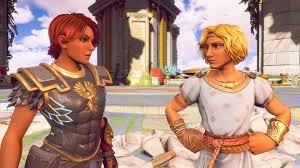
That sense of curation extends to its protagonist, Fenyx, whose performance anchors the game’s tonal balancing act. Voiced by Elana Dunkelman (female Fenyx) or Jonas Papaspyrou (male Fenyx), the character is defined less by grand speeches than by reactive timing. There is a lightness to the delivery, a quickness in response, a slight upward lilt at the end of lines that conveys curiosity without slipping into naivety. Fenyx is not a stoic hero but an observer-participant, someone whose emotional register adapts to the absurdity around them.
Equally important is the dual narration provided by Zeus and Prometheus. Their dynamic part commentary, part argument, introduces a meta-theatrical layer that shapes the player’s experience. Timing is crucial here: jokes land not through volume but through rhythm, often interrupting or reframing the action in progress. Zeus, in particular, is performed with a kind of blustering immediacy, his lines delivered with exaggerated confidence that borders on self-parody. Prometheus, by contrast, offers a measured counterpoint, his tone more deliberate, his humour drier. The interplay between them creates a narrative texture that is as much about storytelling as it is about story.
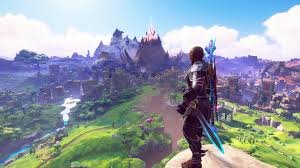
From a craft perspective, Immortals Fenyx Rising distinguishes itself through cohesion rather than technical ambition. Its visual style leans into stylisation, favouring bold colours and exaggerated forms over photorealistic detail. The result is a world that feels painterly, almost illustrative, golden fields, cerulean seas, and marble ruins rendered with a clarity that supports both navigation and tone. This is not merely aesthetic; it reinforces the game’s mythological framing, positioning the environment as a kind of living fresco.
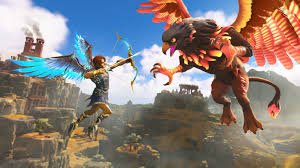
Animation, particularly in traversal, is fluid and expressive. Climbing, gliding, and sprinting are integrated into a movement system that prioritises continuity. Transitions between actions are smooth, reducing friction and encouraging experimentation. The editing “rhythm” of gameplay, how quickly one moves from puzzle to combat to exploration, is tightly controlled. Vaults of Tartaros, the game’s self-contained puzzle dungeons, act as punctuation marks, offering concentrated challenges that contrast with the openness of the overworld.
Sound design complements this structure. Environmental audio is bright and legible, with distinct cues for interactive elements. The score, composed by Gareth Coker, blends orchestral motifs with lighter, almost whimsical flourishes. It rarely overwhelms; instead, it underscores, shifting subtly between exploration and combat. Voice work remains foregrounded, ensuring that the narrative framing so central to the game’s identity never recedes.
Beneath its humour, Immortals Fenyx Rising engages with themes of identity and authorship. Its reimagining of Greek mythology is not merely cosmetic; it interrogates the stories themselves. By allowing its narrators to revise, embellish, and occasionally contradict events, the game highlights the constructed nature of myth. Heroes are not born but narrated into significance; monsters are as much products of perception as of fact.
There is also an undercurrent of self-awareness about heroism. Fenyx’s journey is less about destiny than about interpretation, how one chooses to understand and respond to the roles imposed upon them. This thematic layer, while never heavy-handed, lends the game a surprising depth. It suggests that stories, like worlds, are systems to be navigated and reshaped.
Playing Immortals Fenyx Rising is, above all, a tactile pleasure. Movement feels responsive, combat systems are readable, and puzzles strike a balance between challenge and accessibility. Encounters emphasise pattern recognition and spatial awareness rather than brute difficulty, making success feel earned without becoming punishing. The game’s structure encourages a rhythm of discovery, spotting a distant objective, charting a path, and improvising along the way.
Yet this accessibility comes with trade-offs. Combat, while satisfying, lacks the escalating complexity found in more demanding action games. Enemy variety, though visually distinct, does not always translate into mechanical diversity. Over time, patterns repeat, and the sense of novelty diminishes. Similarly, the game’s humour, initially refreshing, can edge toward over-familiarity, its tonal consistency occasionally flattening its impact.
Pacing remains largely effective, thanks to the modular design of activities, but the accumulation of similar tasks can create a sense of repetition in later stages. The game rarely falters outright; instead, it risks becoming predictable, a subtle but persistent erosion of its early charm.
Still, these shortcomings do little to undermine its central achievement. Immortals Fenyx Rising succeeds because it understands the value of clarity. Its systems are transparent, its tone consistent, its ambitions well-defined. It does not attempt to be everything; it focuses on being itself, and does so with conviction.
Two lines capture its essence:
“A mythological playground where systems and storytelling share the same sense of humour.”
“Not a reinvention of the open world, but a reminder of how joyful it can be.”
In the end, Immortals Fenyx Rising stands as one of Ubisoft’s most cohesive modern titles, a game that trades scale for character, density for design. It may borrow liberally from its influences, but it reshapes them into something distinct: a world where myth is not just retold, but playfully rewritten.
Rating: 8.5/10