
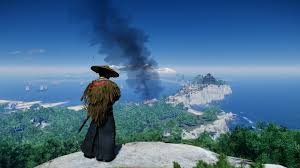
Few games arrive with the quiet confidence of a blade unsheathed, and Ghost of Tsushima strikes with both precision and poetry. From the moment wind scours the golden fields of Tsushima, the game announces itself not merely as a tale of conquest and resistance but as an aesthetic and philosophical meditation on honour, violence, and legacy. Sucker Punch Productions, long celebrated for its work on the inFamous series, has pivoted from superhero spectacle to historical epic with remarkable dexterity, delivering a samurai experience that feels both immersive and profoundly human.
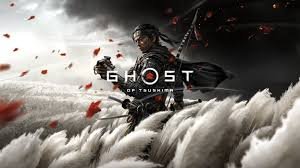
Director Nate Fox, whose narrative sensibilities were honed across Sucker Punch’s previous projects, treats the island of Tsushima as a character in its own right. Unlike other open-world games such as Assassin’s Creed Valhalla, which often prioritise breadth over intimacy, Ghost of Tsushima curates its spaces with painterly attention. Each grove of bamboo, each wind-swept cliff, feels carefully orchestrated to reinforce Jin Sakai’s internal conflict: the tension between rigid honour and the brutal necessities of survival. Where Sekiro: Shadows Die Twice celebrates lethal precision in combat and reflexive challenge, Tsushima balances violence with contemplation, offering a pace that encourages both mastery and reflection.
At the heart of the experience is Jin Sakai, portrayed with understated gravitas by Daisuke Tsuji. Tsuji’s performance is a masterclass in restraint. He conveys centuries of samurai discipline through subtle shifts: the barely perceptible tightening of a jaw, the deliberate pacing of each footstep, and the cadence of his speech that oscillates between ceremonial formalism and raw urgency. These moments feel lived-in rather than acted, a rarity in motion-captured performances where exaggeration can overshadow nuance. Supporting roles, notably a stoic yet emotionally resonant performance from actor Leonard Wu as Lord Shimura, provide a counterpoint that deepens the narrative’s moral complexity.
Technically, Ghost of Tsushima is a triumph. Its cinematography is enhanced by an innovative “Kurosawa mode” that recreates monochrome film with grain, framing, and wind-blown motion turns gameplay into a moving painting. Animation is fluid, and combat sequences are choreographed like high-wire dance, where timing, spacing, and weight carry emotional significance. Editing is deft: the transition between exploration, dialogue, and battle is seamless, reinforcing immersion rather than interrupting it. Production design anchors the game in history without feeling constrained by it; villages, shrines, and encampments reflect cultural authenticity while subtly guiding player exploration. Complementing this is the score by Ilan Eshkeri and Shigeru Umebayashi, whose blend of traditional Japanese instrumentation with cinematic swells accentuates both quiet moments of reflection and the visceral thrill of battle.
Beneath the surface, Ghost of Tsushima is a meditation on duality. It interrogates the constructs of honour and the morality of violence. Jin’s journey, torn between the samurai code and the pragmatism of a guerrilla fighter, mirrors broader human dilemmas: when does survival justify compromise, and at what cost do ideals persist? The game subtly engages with themes of cultural identity and invasion, presenting not merely an exoticised historical tableau but a canvas for reflection on resilience, duty, and ethical ambiguity.
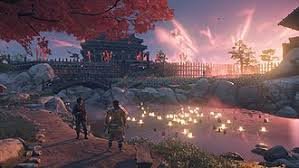
Playing Ghost of Tsushima is as much about sensation as strategy. The island’s open-world design encourages serendipitous discovery: a hidden fox shrine, a forgotten village, a snow-dusted peak revealing a panoramic vista. Combat oscillates between tension and exhilaration, demanding precision in swordplay yet rewarding improvisation with stealth. Pacing is largely impeccable, with narrative interludes that allow players to breathe amidst escalating stakes. Yet the game is not without risk: its sprawling side quests occasionally dilute thematic focus, and while the Mongol invasion provides a compelling antagonist, some skirmishes can feel mechanically repetitive. Even so, these minor lapses are overshadowed by the sheer elegance of the core experience.
In the broader genre landscape, Ghost of Tsushima positions itself as a bridge between action-adventure and contemplative narrative. Unlike the relentless difficulty of Dark Souls or the narrative-driven urgency of The Last of Us Part II, Tsushima encourages reflection without sacrificing agency. Players are invited to inhabit Jin’s world fully, to weigh choices, and to feel the consequences of each swing of the katana. Comparisons are inevitable, but the game consistently distinguishes itself through mood, atmosphere, and thematic resonance.
Ultimately, Ghost of Tsushima is a rare convergence of artistry and gameplay. It demonstrates that an open-world samurai epic can be simultaneously beautiful, brutal, and intellectually engaging. Sucker Punch has crafted more than a game; it is a meditation on history, honour, and the choices that define us, delivered with the precision of a master swordsman and the sensitivity of a storyteller attuned to human nuance.
For players seeking an experience that balances philosophical depth with kinetic thrill, Ghost of Tsushima is a triumph. It stands as both a milestone for Sucker Punch and a benchmark for the genre: immersive, reflective, and uncompromisingly elegant.
★9.5/10
A masterful duel between history, morality, and artistry, executed with breathtaking poise.