
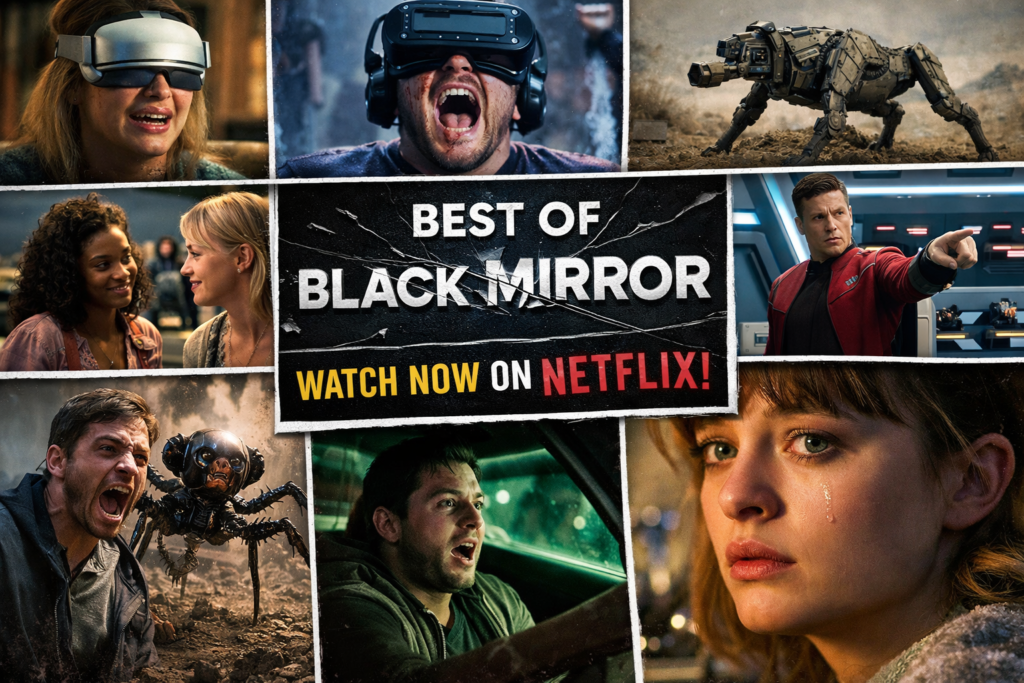
Anthology series often promise variety but deliver inconsistency; Black Mirror does something more unsettling. It thrives on inconsistency. Its brilliance and its occasional frustration lie in its refusal to settle into a single mode, tone, or moral posture. What binds its disparate stories is not narrative continuity, but a shared fixation: the uneasy intimacy between human desire and the technologies that amplify it.
Created by Charlie Brooker, Black Mirror emerged at a moment when digital life was shifting from novelty to infrastructure. Early episodes, particularly those produced under the constraints of British television, carried a raw, almost abrasive clarity. They were less concerned with predicting the future than with reframing the present, exposing the quiet absurdities embedded in everyday interactions with screens, platforms, and systems of validation. As the series expanded most notably through its partnership with Netflix its scope widened, its budgets increased, and its sensibilities grew more global. What it gained in scale, it occasionally risked losing in precision.

To situate Black Mirror within its genre is to acknowledge both its lineage and its divergence. It echoes the moral parables of The Twilight Zone, yet replaces supernatural ambiguity with technological determinism. It shares thematic ground with films like Her and Ex Machina, both of which interrogate the emotional consequences of artificial intelligence, but Brooker’s series is less interested in intimacy than in exposure. Where those films often humanise technology, Black Mirror tends to weaponise it, turning familiar tools into instruments of psychological and social revelation.
The anthology format allows for a rotating cast of performers, and the series consistently attracts actors willing to calibrate their work to its distinct tonal demands. Episodes such as “San Junipero” showcase performances of remarkable restraint, where emotional shifts are conveyed through subtle changes in posture and vocal softness. Others, like “Shut Up and Dance,” demand a more reactive intensity, with actors navigating escalating panic through fragmented speech and increasingly erratic physicality. What unites these performances is a shared understanding of the show’s central tension: characters are often aware, at least partially, of the systems trapping them, yet remain unable to disengage.
Technically, Black Mirror operates with a level of craft that often goes underappreciated. Its visual style adapts to the needs of each story, but certain patterns emerge. Cinematography frequently favours clean, almost clinical compositions, reflecting worlds where technology has streamlined chaos into something deceptively orderly. This aesthetic can shift dramatically warmer, nostalgic palettes in episodes like “San Junipero,” colder, desaturated tones in darker instalments, but the underlying principle remains: the environment mirrors the psychological state.
Editing is perhaps the series’ most crucial tool. Pacing varies widely between episodes, yet it is always deliberate. Some stories unfold with a slow, creeping inevitability, allowing dread to accumulate almost imperceptibly. Others accelerate toward their conclusions, using rapid cuts and narrative compression to mimic the overwhelming nature of digital overload. The result is a viewing experience that feels tailored rather than standardised, each episode calibrated to its own internal logic.

Production design plays a vital role in grounding the speculative elements. The technologies depicted are rarely fantastical; they are extensions, iterations, or slight exaggerations of existing tools. This design philosophy reinforces the show’s central conceit: the future is not a distant horizon, but a slight deviation from the present. Devices are sleek but familiar, interfaces intuitive, environments recognisable. It is precisely this plausibility that makes the series’ darker implications resonate.
Sound design and score are used with similar intentionality. Silence often precedes moments of revelation, creating a vacuum that heightens tension. When music is employed, it tends to underscore rather than dictate emotion, allowing the narrative to maintain its unsettling ambiguity. In some episodes, the absence of a traditional score amplifies the realism, making the events feel less like fiction and more like documentation.
At its thematic core, Black Mirror is less about technology than about amplification. It explores how existing human impulses, vanity, loneliness, cruelty, and longing are intensified by systems designed to reward engagement. The series resists the temptation to frame technology as inherently malevolent; instead, it suggests that the danger lies in its alignment with human weakness. This nuance distinguishes it from more simplistic dystopian narratives, positioning it as a critique not of innovation, but of intention.
However, the series’ ambition is also its Achilles’ heel. Its later seasons, particularly under the weight of increased expectations, occasionally veer toward self-parody. The twist endings that once felt revelatory can begin to feel obligatory, their impact diminished by predictability. Some episodes overextend their concepts, prioritising shock over substance, while others retreat into safer, more conventional storytelling. The balance between provocation and profundity is delicate, and Black Mirror does not always maintain it.
Yet even at its most uneven, the series retains a capacity to unsettle. It understands that its power lies not in forecasting specific technologies, but in articulating a pervasive unease the sense that we are complicit in the systems that shape us. Watching Black Mirror is an exercise in recognition as much as imagination. It does not simply ask, “What if?” but “Why does this feel inevitable?”
“Black Mirror doesn’t predict the future, it refracts the present until it becomes unbearable to ignore.”
“Its most disturbing insight is not that technology will change us, but that it already has.”
In the end, Black Mirror endures because it refuses comfort. It offers no solutions, no easy moral resolutions, only a series of reflections distorted, exaggerated, yet uncomfortably familiar. To watch it is to confront the possibility that the darkest visions it presents are not warnings, but mirrors held just close enough to see clearly.
Rating: ★★★★☆ (4/5)
Should you watch it? Yes, especially if you’re drawn to thought-provoking, unsettling stories that explore the psychological and societal impact of technology.