

There is a particular kind of dread that modern survival dramas trade in, not the fear of death itself, but the creeping suspicion that survival has no moral centre. Alice in Borderland understands this intimately. It is less interested in whether its characters live or die than in what those outcomes reveal about the fragile architectures of identity, loyalty, and meaning under pressure. In a genre increasingly crowded with nihilistic game theory, this series distinguishes itself by refusing to let despair remain abstract; it forces it into confrontation with human need.
Adapted from the manga by Haro Aso and directed with controlled volatility by Shinsuke Sato, Alice in Borderland arrives in the wake of global fascination with death-game narratives. Comparisons to Squid Game are inevitable, but reductive. Where Squid Game weaponised economic desperation with surgical clarity, Alice in Borderland leans into existential dislocation; its deserted Tokyo is not just a setting, but a psychological vacuum. Likewise, it shares DNA with Cube in its fascination with puzzle-based survival, yet diverges in its emotional intensity, favouring character rupture over intellectual detachment.
From its opening stretch, the series signals a bold, almost reckless ambition: it is not content to merely stage games, but to interrogate the very premise of play. The rules are often opaque, the logic intentionally destabilising. This unpredictability becomes both its greatest strength and its most persistent risk. Unlike more mechanically precise genre entries, Alice in Borderland thrives on imbalance; it wants the viewer to feel unmoored, to experience confusion as a feature rather than a flaw.
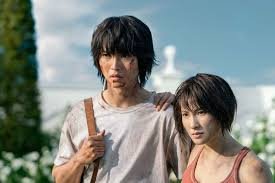
At the centre is Ryohei Arisu, portrayed by Kento Yamazaki with a carefully modulated vulnerability. Yamazaki avoids the trap of passive relatability; his Arisu is observant to the point of paralysis, a young man whose intelligence becomes both an asset and a burden. His performance hinges on stillness—long pauses, hesitant speech, a physicality that seems perpetually on the verge of retreat. It’s a subtle portrayal of someone learning, painfully, that survival may demand the abandonment of self-image.
Opposite him, Yuzuha Usagi, played by Tao Tsuchiya, offers a counterpoint of embodied resilience. Tsuchiya’s performance is grounded in physical precision: her movements are economical, her posture alert, as if every muscle is calibrated for survival. Where Arisu internalises conflict, Usagi externalises it through action, and the dynamic between them evolves into one of the series’ emotional anchors. Their chemistry is not romantic in the conventional sense; it is forged through mutual recognition of trauma, a quiet acknowledgement of shared fracture.

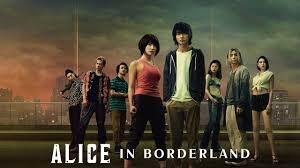
Supporting characters are often drawn with broader strokes, yet the series grants them moments of startling specificity. Whether through a fleeting gesture or a sudden shift in vocal tone, these characters are allowed to exist as more than narrative functions. Even antagonists are rarely reduced to caricature; instead, they are framed as alternate responses to the same existential crisis, each embodying a different philosophy of survival.
Visually, Alice in Borderland is striking in its commitment to scale and emptiness. The depiction of Tokyo as eerily vacant, stripped of its usual density, creates a dissonant beauty. Wide shots linger just long enough to emphasise absence, while tighter frames trap characters within the geometry of their circumstances. The cinematography balances spectacle with intimacy, using contrast to underscore the tension between isolation and connection.
The editing rhythm is deliberately uneven. Moments of frenetic action are punctuated by extended stillness, allowing the psychological weight of events to settle. This pacing can be disorienting, occasionally to a fault, but it reinforces the series’ thematic preoccupation with instability. The production design of the game arenas is particularly noteworthy: each environment feels conceptually distinct, reflecting the psychological dimension of the challenge it houses. These are not merely obstacles, but manifestations of fear, trust, and moral compromise.
Sound design plays a crucial role in shaping the viewing experience. Silence is weaponised as effectively as any musical cue, often preceding moments of revelation or catastrophe. When the score does emerge, it tends toward restraint rather than bombast, allowing tension to build organically. The result is an atmosphere that feels less orchestrated than inevitable, as though events are unfolding according to some indifferent logic.
Beneath its surface mechanics, Alice in Borderland grapples with questions that resist easy resolution. What does it mean to live meaningfully when survival is arbitrary? Can moral frameworks persist in environments designed to dismantle them? The series does not offer definitive answers, but it does suggest that meaning is not discovered, but constructed often in defiance of circumstance. In this sense, it echoes the philosophical undercurrents of Battle Royale, though it replaces that film’s satirical edge with a more introspective tone.
Yet the series is not without its shortcomings. Its ambition occasionally tips into overextension, with narrative threads that strain under the weight of their own significance. Certain twists feel less like organic developments and more like attempts to outpace audience expectations. The balance between mystery and coherence is delicate, and Alice in Borderland does not always maintain it. At times, the opacity of its rules risks disengagement, particularly for viewers seeking a more structured narrative experience.
Still, these flaws are inseparable from what makes the series compelling. Its willingness to embrace uncertainty, to let questions linger unanswered, gives it a distinctive texture. Watching Alice in Borderland is not a passive experience; it demands attention, interpretation, and, occasionally, patience. It is a series that trusts its audience enough to unsettle them.
“Alice in Borderland turns survival into a philosophical experiment, one where the cost of living is measured in identity.”
“It isn’t the games that haunt you, but the realisation that they may be beside the point.”
In the end, Alice in Borderland is less about escape than confrontation. It strips away the illusions of control that define everyday life and replaces them with a stark question: when everything is reduced to choice and consequence, who are you willing to become?
Rating: ★★★★☆ (4/5)
Should you watch it? Yes, especially if you’re drawn to psychologically intense, visually striking survival dramas that value ambiguity as much as adrenaline.