

In an era when political thrillers often confuse convolution for depth, The Night Agent makes a more pragmatic bet: that audiences are less interested in labyrinthine conspiracies than in the reassuring spectacle of competence. It is a series built not on surprise, but on execution on the steady, procedural unravelling of danger by people who, against institutional inertia, still believe in doing their jobs well. That alone feels faintly radical.
Created by Shawn Ryan, whose résumé includes the muscular storytelling of The Shield, The Night Agent positions itself as a return to form for the network-style thriller, albeit filtered through streaming sensibilities. It lacks the baroque ambition of House of Cards and the moral ambiguity of 24, but it compensates with clarity of purpose. This is not a show interested in reinventing the genre; it is interested in refining it, sanding down its excesses until only momentum remains.

From its opening movements, The Night Agent signals a controlled, almost old-fashioned confidence. The premise a low-level FBI agent monitoring an emergency phone that rarely rings could easily tilt toward gimmick. Instead, the series treats it as a narrative engine, a mechanism through which tension is both generated and sustained. When the call finally comes, it does not explode into chaos so much as it accelerates into inevitability.
At the centre is Peter Sutherland, played by Gabriel Basso with a deliberate lack of flourish. Basso’s performance is defined by restraint his line delivery is unadorned, his physicality grounded, his emotional register tightly controlled. This is not a charismatic hero in the traditional sense; it is a man whose defining trait is reliability. In another series, that might read as blandness. Here, it becomes a kind of quiet authority.
Opposite him, Rose Larkin, portrayed by Luciane Buchanan, injects a different energy. Buchanan plays Rose not as a passive participant in the conspiracy, but as an active interpreter of it. Her performance is marked by sharp vocal shifts moments of panic that give way to analytical focus suggesting a character who processes fear by dissecting it. The chemistry between Basso and Buchanan is understated but effective, rooted less in overt emotion than in mutual dependence.
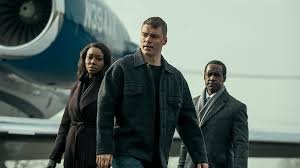
The supporting cast operates with similar efficiency. Hong Chau brings a measured ambiguity to her role, using minimal gestures to suggest layers of intention, while Fola Evans-Akingbola adds a note of controlled scepticism that grounds the more speculative elements of the narrative. These performances do not compete for attention; they reinforce the series’ central ethos of professionalism under pressure.
Technically, The Night Agent favours precision over flair. The cinematography is functional but purposeful, relying on clean compositions and controlled camera movement to maintain spatial clarity. There are a few indulgent flourishes; even action sequences are staged with an emphasis on coherence rather than spectacle. This approach aligns the series more closely with films like Michael Clayton than with the hyper-stylised espionage of John Wick. The goal is not to dazzle, but to sustain.
Editing plays a crucial role in this balancing act. The rhythm is brisk without feeling rushed, allowing scenes to breathe just long enough to establish stakes before moving forward. Cross-cutting is used sparingly but effectively, often to juxtapose personal vulnerability with institutional power. The production design, particularly in its depiction of government spaces, leans into authenticity offices feel lived-in, corridors claustrophobic, environments designed for function rather than grandeur.
The score and sound design operate in a similarly restrained register. Rather than overwhelming scenes with urgency, the series allows tension to accumulate organically. Silence is frequently employed as a counterpoint, creating moments where the absence of sound becomes its own form of pressure. This understated approach reinforces the show’s commitment to realism, even as its narrative edges toward the improbable.
Beneath its procedural surface, The Night Agent is concerned with the erosion and possible restoration of trust. Institutions are depicted as both necessary and compromised, populated by individuals whose motives are not always aligned with their roles. The series resists the temptation to collapse this complexity into cynicism; instead, it suggests that integrity can persist, albeit precariously, within flawed systems. In this respect, it echoes the thematic concerns of Michael Clayton, though it trades that film’s moral ambiguity for a more optimistic outlook.

This optimism, however, is also where the series occasionally falters. Its commitment to forward momentum sometimes comes at the expense of depth, with certain character arcs feeling underdeveloped. Twists, while generally effective, can lean toward predictability, and the central conspiracy though engaging rarely achieves the sense of existential threat that the genre’s best entries sustain. The series is at its strongest in moments of process, weaker when it reaches for grandeur.
And yet, to focus solely on these limitations is to miss the point. The Night Agent is not trying to overwhelm; it is trying to deliver. It understands that tension is not a function of complexity, but of clarity of knowing exactly what is at stake and why it matters. Watching it is less an exercise in decoding than in immersion, a steady accumulation of pressure that rarely lets up.
“The Night Agent proves that precision can be as compelling as spectacle.”
“In a genre addicted to excess, its greatest strength is knowing exactly how much is enough.”
Ultimately, The Night Agent succeeds not because it reinvents the political thriller, but because it respects it. It trusts in the enduring appeal of well-drawn characters, coherent stakes, and narrative discipline. In doing so, it offers something increasingly rare: a thriller that values control over chaos, and finds its power in that restraint.
Rating: ★★★★☆ (4/5)
Should you watch it? Yes, especially if you prefer tightly constructed, character-driven thrillers that prioritise tension over spectacle.